Price range: $ 310 through $ 912
Esketamine Nasal Spray is an innovative, rapid-acting prescription medication engineered for adult patients struggling with major depressive disorder (MDD) and treatment-resistant depression (TRD). Designed to target neurotransmitter pathways distinct from traditional monoaminergic antidepressants, this therapy offers a critical option for individuals who have not achieved adequate relief from standard therapies. As a Schedule III controlled substance delivered through a single-use nasal device, it is administered strictly under direct healthcare provider supervision within certified medical settings.
Esketamine Nasal Spray is an innovative, rapid-acting prescription medication engineered for adult patients struggling with major depressive disorder (MDD) and treatment-resistant depression (TRD). Designed to target neurotransmitter pathways distinct from traditional monoaminergic antidepressants, this therapy offers a critical option for individuals who have not achieved adequate relief from standard therapies. As a Schedule III controlled substance delivered through a single-use nasal device, it is administered strictly under direct healthcare provider supervision within certified medical settings.
Esketamine Nasal Spray is indicated for specific, highly challenging clinical presentations of major depressive disorder in adults. It is evaluated and prescribed primarily under two clinical scenarios:
Treatment-Resistant Depression (TRD): Indicated for adult patients who have failed to achieve an adequate response to at least two different oral antidepressant treatments of adequate dose and duration during the current depressive episode. In this population, it is co-administered alongside a newly initiated or existing oral antidepressant.
Major Depressive Disorder with Acute Suicidal Ideation or Behavior: Indicated for the rapid reduction of depressive symptoms in adults with MDD experiencing acute suicidal thoughts or actions. It serves as a rapid-onset intervention alongside standard comprehensive clinical care.
Suicide Prevention: While Esketamine Nasal Spray rapidly reduces core depressive symptoms, its direct efficacy in preventing suicide or reducing suicidal ideation long-term has not been conclusively established as a standalone therapy.
Clinical Hospitalization: The use of this treatment does not replace the necessity for inpatient hospitalization if emergency psychiatric admission is clinically warranted.
Anesthetic Use: The drug is not approved or indicated for use as an anesthetic agent.
Understanding the pharmacodynamics of Esketamine Nasal Spray highlights why it represents a major shift from traditional SSRIs, SNRIs, and tricyclic antidepressants.
+-----------------------------------------------------------------------------------+
|                            MECHANISM OF ACTION                                    |
+-----------------------------------------------------------------------------------+
|  1. Non-Competitive NMDA Receptor Antagonism                                      |
|     Blocks N-methyl-D-aspartate (NMDA) ionotropic glutamate receptors in the CNS. |
|                                                                                   |
|  2. Transient Glutamate Surge & AMPA Activation                                   |
|     Disinhibits GABAergic interneurons, causing a burst of cortical glutamate     |
|     release that stimulates α-amino-3-hydroxy-5-methyl-4-isoxazolepropionic    |
|     acid (AMPA) receptors.                                                     |
|                                                                                   |
|  3. Downstream Synaptogenesis & Neuroplasticity                                   |
|     Triggers neurotrophic signaling pathways (BDNF & mTOR complex), restoring      |
|     synaptic connections in mood-regulating brain regions.                  |
+-----------------------------------------------------------------------------------+
Enantiomer Specificity: Esketamine is the $S$-enantiomer of racemic ketamine, possessing a higher binding affinity for the NMDA receptor pore than the $R$-enantiomer.
Bioavailability & Onset: Intranasal delivery facilitates rapid systemic absorption through the nasal mucosa. Onset of therapeutic effect often begins within hours to 24 hours post-dose, contrasting sharply with the 4 to 6 weeks typically required for conventional oral antidepressants.
Metabolism: Primarily metabolized in the liver via cytochrome P450 enzymes (CYP2B6 and CYP3A4) into active metabolites (noresketamine), which are subsequently eliminated via renal routes.
Administration of Esketamine Nasal Spray must follow strict clinical protocols due to the drug’s potent central nervous system effects and regulatory requirements.
Food and Fluid Restrictions: Patients must abstain from eating food for at least 2 hours and drinking liquids for at least 30 minutes prior to administration to reduce the incidence of nausea and vomiting.
Nasal Decongestants: If nasal corticosteroids or decongestants are required, they should be administered at least 1 hour prior to dosing.
Baseline Vital Signs: Blood pressure must be assessed before dosing. If baseline blood pressure is elevated (e.g., $>140/90$ mmHg in high-risk patients), dosing should be delayed until values are stabilized.
| Indication | Treatment Phase | Frequency | Recommended Dosage |
| Treatment-Resistant Depression (TRD) | Induction Phase (Weeks 1–4) | Twice weekly | Day 1 starting dose: 56 mg. Subsequent doses: 56 mg or 84 mg. |
| Maintenance Phase (Weeks 5–8) | Once weekly | 56 mg or 84 mg based on response. | |
| Ongoing Maintenance (Week 9+) | Every 2 weeks or once weekly | Individualized lowest effective dose (56 mg or 84 mg). | |
| MDD with Suicidal Ideation | Acute Treatment (Weeks 1–4) | Twice weekly | Starting dose: 84 mg. May reduce to 56 mg if tolerability requires. |
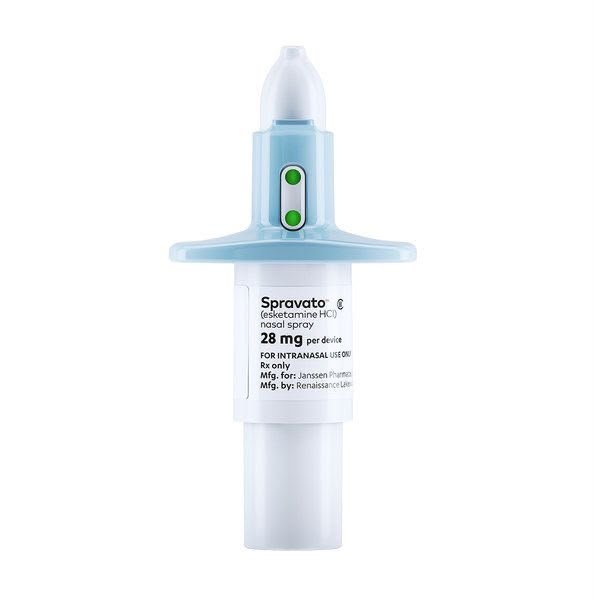
Each single-use device delivers a total of 28 mg of esketamine via two metered sprays (one spray per nostril).
56 mg Dose: Utilizes 2 nasal spray devices.
84 mg Dose: Utilizes 3 nasal spray devices.
Rest Period: The patient must rest comfortably for 5 minutes between each device to ensure proper absorption into the nasal mucosa.
Because of the potential for severe adverse reactions, misuse, and dependence, Esketamine Nasal Spray carries prominent warning labels and boxed safety information.
WARNING: SEDATION, DISSOCIATION, RESPIRATORY DEPRESSION, ABUSE/MISUSE, AND SUICIDAL THOUGHTS
Sedation & Dissociation: Patients are at high risk of experiencing marked sedation, altered perception, loss of consciousness, and dissociative symptoms following administration.
Respiratory Depression: Respiratory monitoring is required during post-dose observation.
Abuse Potential: Esketamine is a Schedule III controlled substance and carries risk for misuse and diversion.
REMS Program: Due to these risks, Esketamine Nasal Spray is only available through a restricted distribution program called the Risk Evaluation and Mitigation Strategy (REMS).
Absolute Contraindications:
Patients with aneurysmal vascular disease (including thoracic and abdominal aortic aneurysms).
History of intracerebral hemorrhage.
Known hypersensitivity to esketamine, ketamine, or any product excipients.
Precautions:
Cardiovascular Disease: Transient blood pressure elevations peak roughly 40 minutes post-dose. Caution is required in patients with unstable hypertension, recent myocardial infarction, or heart failure.
Pregnancy & Lactation: Exposure during pregnancy may cause fetal harm. Embryo-fetal toxicity has been demonstrated in animal models. Breastfeeding is not recommended during treatment.
Post-administration management is essential to ensure patient safety and comfort.
2-Hour Minimum Observation: Patients must be monitored in a certified healthcare setting by a trained professional for a minimum of 2 hours post-dose.
Blood Pressure Checks: Blood pressure should be re-evaluated at approximately 40 minutes post-dose and as clinically indicated until stabilized.
Driving Restriction: Patients must not drive, operate heavy machinery, or engage in hazardous activities until the next day following a restful night’s sleep.
Post-Dose Timeline:
[0 min: Dose Administered] ---> [40 min: Peak BP & Dissociation Check] ---> [120 min: Clinical Stability Assessment & Discharge]
Very Common Adverse Reactions ($\ge 10\%$):
Dissociation and perceptual distortion
Dizziness and vertigo
Nausea and vomiting
Sedation, somnolence, and lethargy
Hypoesthesia and dysgeusia (unpleasant taste)
Transient elevation of systolic/diastolic blood pressure
Anxiety and headache
Gastrointestinal Management: Nausea is typically transient. Fasting guidelines before administration significantly reduce the likelihood of emesis.
Proper storage and strict compliance with controlled substance regulations are mandatory for facilities handling Esketamine Nasal Spray.
Temperature: Store at $20^\circ\text{C}$ to $25^\circ\text{C}$ ($68^\circ\text{F}$ to $77^\circ\text{F}$), with permitted excursions between $15^\circ\text{C}$ and $30^\circ\text{C}$ ($59^\circ\text{F}$ to $86^\circ\text{F}$).
Security: Must be maintained in a secure, locked controlled-substance storage area in compliance with local, state, and federal Schedule III drug enforcement regulations.
Spent and partially used devices must be documented and disposed of according to institutional protocols for Schedule III controlled waste and local environmental regulations. Devices must never be sent home with patients.
Esketamine Nasal Spray represents a critical advancement in interventional psychiatry for adults battling severe, treatment-resistant forms of depression. By leveraging a novel mechanism of action through NMDA receptor modulation, it provides rapid clinical relief when standard oral therapies prove insufficient. When paired with rigorous REMS compliance, structured clinical monitoring, and appropriate patient selection, Esketamine Nasal Spray delivers a transformative, evidence-based therapeutic path toward functional recovery.
| DOSE | 28 mg, 1 device, 56 mg, 2 devices, 84 mg 3 devices |
|---|

 English English
  Italiano
 Deutsch
 Nederlands
 Español
 Dansk
Dansk
 Français
 Ελληνικά
 Svenska
 Suomi
Suomi
 Polski
 Português
 العربية